
Home › Forums › Standing Out in the Field › Time beyond Stories
Tagged: time
- This topic has 0 replies, 1 voice, and was last updated 12/22/2025 at 12:02 PM by Michael Gray.
-
AuthorPosts
-
-
December 22, 2025 at 12:02 pm #1257
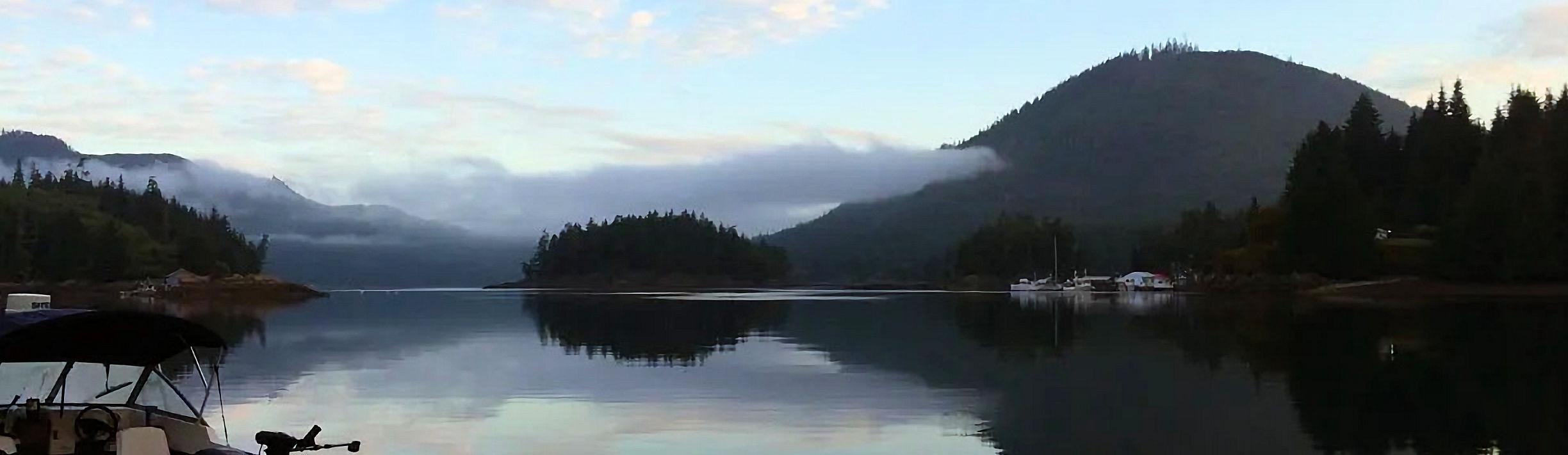
Knight Inlet, British Columbia
“How you engage and appreciate time shapes the way you narrate your life.”
“Gesture of Great Love” by Tarthang Tulku.Living as I do, inside the story that time is a sequence of fleeting present moments—each one wedged between an inaccessible past on one side and a future that never shows up on the other—I have to wonder if there is a greater time that is more coherent, more open to the fullness of being,
There are certainly more inspiring stories about time than that it is a series of drum beats counting down from birth until death.
Time is a flowing river carrying me along. Time is a rising wind that will lift me aloft, if I can just relinquish my need to always be in control. If telling stories is the only way to know I am alive, then let me at least thank time for each breath and each heartbeat, even though I hardly ever notice them.
In my search for lost time, I hope to challenge my ingrained belief that time is a linear sequence in which everything that happens comes out of an unknowable future, flies through a fleeting present moment, then vanishes into a past that I can relive in memory but never change. In that story, my experience is propelled along in an unstoppable current running between two shores on which I can never land.
Let me try a different approach. What would it be like to live—not in the past, not in the future, not in the kind of present I now know—but in a time where past, present and future are one unified whole; like a mother, father and their newborn connected by nature?
Does the wind coming into my neighborhood, hours or days after passing over Sandia Crest, still carry the scent of Ponderosa pines growing a mile above where I now sit in the warmth of an Albuquerque afternoon? I invite that wider perspective to join me now, as I ask if I have ever encountered a different story about time; a story that is not just one more structure assembled from bricks baked in the kiln of a remembered past.
I was younger then, more open to seeing the world with eyes that weren’t as dedicated to finding what I expected to find. A friend and I left Montreal one autumn day, with the idea of working our way south into Central America. By the time we reached New Orleans, we realized that as Canadians, we couldn’t legally work in the U.S. We raced back to Canada–heading to Vancouver and the Pacific Ocean, in order to at least continue the adventure–and with $50 between us drove for three days straight, only stopping for gas.
That was not the time when an unfamiliar vision lapped against the shores of my known world. Nor were the next few weeks: finding a pay-by-the week room, working at a car wash that paid twice a day, so people in our position could buy lunch. Nor was working during the weeks before Christmas at the North Vancouver post office.
Then one day, walking around the Vancouver docks, I saw activity on one of the boats. I approached and asked the man who proved to be the skipper if he needed another crew member. To my surprise, he said if I came back on Monday packed for a week-long trip, I could sail with him.
That was the start of weekly trips sailing north from Vancouver up the coast of British Columbia. With the mainland on the right and Vancouver Island on the left, I still remember the first time that we cleared the protection of the 283-mile-long island and were suddenly in the open Pacific Ocean. With waves that had thousands of miles to gather momentum, I grasped the gunnels for dear life as the bow rose up over a gigantic crest and then plunged down into a trough ten feet below.
That was a vivid story in time, but it was not the experience when I felt a different time arising. Nor were the stops to deliver supplies to logging camps and native communities on the edges of Kings Inlet and Knights Inlet, as they wound their way into the Rocky Mountain foothills. There was magic for me in mooring alongside a wharf—day or night—and unloading sacks of potatoes and flour, boxes of canned good, cereal, cigarettes, whatever that community with no roads to the outside world had ordered that week.
I remember the night-time stops best, with the sheer mountain sides rising into the darkness, the wind blowing, the scent of snow in the air. But those were not moments when time changed its quality and infiltrated the heart of my experience. Those memories were thrilling and outside my familiar life; they float in my memory like chunks of melting ice; stored without any distinction between the inlet we were sailing up or whether a particular stop was at a logging camp or a native community.
It was not then that I experienced the heartbeat of space and time, and felt my inner being looking on in silent awe.
It was nighttime. The captain had given me a quick introduction to the radar, sonar depth-finder, and the navigation charts for the inlet up which we were sailing that night.
Then I was alone in the wheelhouse for the next six hours while the rest of the crew slept. All I had to do was keep the boat in the center of the channel, chugging along at about 15 knots an hour.
At some point, a full moon rose over the mountains to the east, lighting up the water and the cliffs. It felt like being in the center of a bowl whose edges were formed by those mountains. It was impossible to tell by eyesight where the channel was heading. In all directions, there was a ring of peaks, with the supply boat idling in the center. It felt as if the boat was just vibrating in place, like a bee hovering above a bird bath. I could only know where the channel was heading by looking at the radar. On its illuminated screen, a green map was being constantly drawn, as the radar dish rotated on the roof of the wheelhouse, revealing the boat’s distance from the surrounding mountains. It was only on that screen that the nearer and farther edges of the channel could be seen: showing up as a black space where the water was threading its way ahead.
Remembering that time, I thought I was dependent on the radar to thread through the channel; since looking out the wheelhouse windows, I just saw mountains everywhere.
But it occurs to me now that I wasn’t completely dependent on that radar in the way a bat depends on its sonar. With the moon illuminating the mountains around me, it felt like being in the center of an unchanging bowl of light; but if I had kept sailing straight ahead, eventually the wall ahead would have come closer. I would have known to turn the wheel and adjust our heading back toward the middle of the channel that was itself invisible except on the radar screen.
I was directly aware of my surroundings, and they would have told me when I needed to move back into the middle of the stream.
It would have been folly to ignore the radar, since it allowed me to make continuous adjustments long before I saw a rocky wall looming dangerously close. But part of me was already at the heart of a luminous living world, with no need for any outside guidance to make my way through time and space.
Together, the radar and the nautical charts, spread out on a table in the wheelhouse, made it as easy to sail up the channel as driving on the blacktop of an interstate highway. But sitting in the wheelhouse, I was also in the middle of a brimming bowl of moonlight, held in a realm of mystery where there was no separation between myself and the luminous world around me.
The saltwater, rising and falling with the tide, even miles inland from the Pacific coast, held the boat and kept it afloat. The tide of moonlight and the vibration under my feet told the tale of another kind of time that filled the world and brimmed over into my heart.
Now, sitting in Albuquerque, salt water is flowing in my veins, dust from ancient mountains fortifies my bones, and moon-drawn tides guide me along my way.
The idea that the movements of my hands on the wheel have ever been needed to keep me afloat, is laughable. Sitting here in New Mexico, I remember Thich Nhat Hanh’s advice and I walk outside. Smiling up at the blue sky, I see the pale face of a half-moon winking back.
~This piece originally appeared in:
ABQ INPRINT ISSUE 9, 2025 BOSQUE PRESS, ALBUQUERQUE, NM.
-
-
AuthorPosts

- You must be logged in to reply to this topic.