
Home › Forums › Standing Out in the Field › The Feel of Knowledgeability
Tagged: Knowledgeability, the "I"
- This topic has 2 replies, 2 voices, and was last updated 07/13/2026 at 12:02 PM by David Filippone.
-
AuthorPosts
-
-
July 3, 2026 at 11:34 am #1266
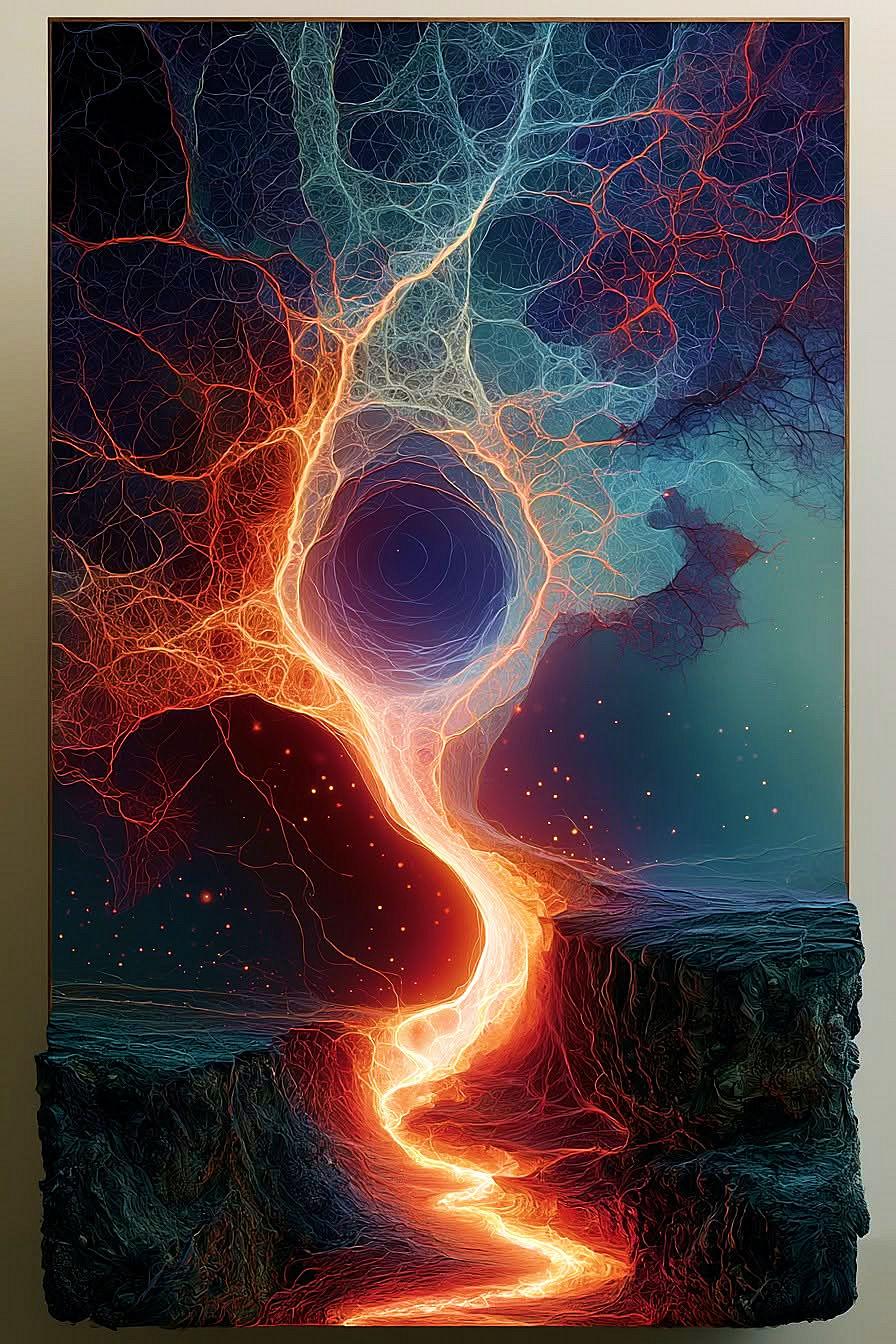 Feel of Knowledgeability, Image – Liminal Art Prints, by Bruce Alderman
This was a recent discussion between 3 dedicated students of the Time, Space, Knowledge Vision (TSK), between David, Eric and Oda. Eric sent us the following quote: [Emphasis added] and a brief discussion followed…
The Crucial Points of Practice (Part 2)
SARVA MANGALAM! ~ Patrul Rinpoche (1808–1887) from “Enlightened Vagabond,” (Matthieu Ricard, 2017)
How to liberate thoughts just as they arise
Since primordial liberation, spontaneous liberation,
Liberation upon arising, direct liberation, and the rest,
Are each and all the crux of view, meditation, and action,
Develop meditation by practicing this crucial point:
Freeing thoughts into their own condition.
Apply this crucial point and there is no need
For any other view nor any other meditation.As all beneficial thoughts arise,
You are free of attachment to them;
Though still striving for virtue, you are free of conceit.As all negative thoughts arise,
They become unraveled naturally,
Like a tangled snake unwinding.
Should even the five poisons arise,
In an instant they are released into their own condition.Neutral thoughts, too, self-settle naturally
Subsiding into the expanse of awareness.
Set free just as they arise, they leave no more imprint
Than the flight of a bird through the sky.Deluded thinking is the very root of samsara.
Once you are certain how to bring discursive thought
Onto the path, through this self-liberation,
That is “freeing samsara and nirvana in the absolute expanse.”Until you master this vital point —
Becoming certain about this method of
Self-liberating discursive thoughts
And thus bringing all circumstances onto the path —
Though you may be able to blather on about emptiness,
Your “realization” is mere theory.Your hidden negative qualities will he naturally exposed.
In the end, the five poisons will prevail
If you mistakenly regard their apparent solidity to be real.Why? Only from the error of not knowing
How to liberate thoughts just as they arise.Therefore, the most important point
About view, meditation, and action,
Which brings about the confidence of realization,
Boils down to mastery of this way
Of self-liberating thoughts just as they arise.Applying this in all circumstances of your life,
Keep bringing everything onto the path toward realization.
Even though I myself have not yet mastered this,Inspired by the words of the omniscient master, the very Buddha,
I have written down these words.
Take these words to heart, since
This is the most crucial, essential point of practice.”Oda responded:
How do thoughts self-liberate? This came up this morning: There is a place that resembles most the phase of deep sleep. From that sensations, thoughts and things arise. That arising is known – not as distant and indifferent, but with a great openness, a curiosity even. In that openness things self-liberate.
David responded:
How do thoughts self-liberate? Not an authority on this, but I’ve noticed… while relaxed near the time’s giving instant, at the future’s edge as we say, patterns and thoughts arise… but often those thoughts are not linked to a previous structured thought like a train, they are not limited by an ordinary track or trajectory, but instead, seem to appear from patterns arising from a less structured openness, a more fundamental level. [something like what Oda previously described to me, as she sat under the trees the other day] There’s a wider focal setting in play. At that point, “I” may assert and choose to structure a thread or series of thoughts, or simply dwell in the openness of the giving instant.
Eric responded:
“How do thoughts self liberate?”— Yes, David & Oda—“a wider focal setting in play”— “…Not linked to a previous structured thought train”—Maybe a …”more fundamental level”—a “less structured openness”—
“How the ‘I’ may assert and choose to structure a thread or series of thoughts, or simply dwell in the openness of the giving instant. “
Liking this inquiry and perhaps where it’s going… But…here’s a rub—let’s say, about it going ‘somewhere’.
“Understanding”—with a capital U. There can be seeing / sensing another person’s limitation—say in how an emotion may be arising, and its personalization, especially when ‘coming from’ a ‘wider focal setting’—That sensing of directionality and “the self liberating of thoughts”— Interesting.
Wondering whether that kind of seeing / sensing that David and Oda are drawing upon—can not only increase understanding and ease and well-being etc—But also that it may lead ‘nowhere’—essentially—& that there is nothing more fundamental than anything else.
Let’s say—there are more ingredients seemingly more available within this “wider setting”—ie spaciousness— But there also is no place to get to, or to have a ‘resulting understanding’ of…. And ‘we’ probably ‘get’ this on some level. Yes? But there may be a tendency in some of us—myself included—to attach meaning and create a conclusion to these insights.
There’s an endless road of possibilities. A-mazing! Compassion, yes. Humility, yes. ‘Greater knowing’ perhaps— And this potential may also be available without following the ‘train of discoveries”— In the openness of ‘the’ unceasing edge of the moment—knowing in the instant— Knowing without a conclusion…. (Does this make sense?)
David responded:
Just to clarify… The Understanding I was referring to is not the understanding of the self-domain, it’s like inspiration that comes not from subject/object dichotomies of reason and logic. It ‘dawns‘ from Knowledgability, the capacity to know the whole. The clarity we see through. We ordinarily tend to isolate it as a conceptual understanding, but it arrives prior to conceptualization, then having arisen… the self claims it as its own, as if “I” came up with it. Don’t know if that helps.
Eric responded:
Yes, David, —better understanding your way of using “understanding”—w/ capital U. Even in the “instant” and “greater understanding” —might there be room for “mis-understanding” —even when “supposedly” the knowing appears beyond the “I” ?
Does not the “I” continue in some form its tendency to claim or reclaim residence (renting perhaps some space?)? Acknowledging too that perhaps there is also some subtle communication here w/ Oda and me that connects with the Tuesday class with Richard?
David responded:
Hi Eric,
According to TSK vision, Rinpoche uses the term Knowledgeability, and says it is a knowing of the whole, it is not limited by the self’s ability to misunderstand. I remember Elon’s discussion with Richard about errors of thought by Rinpoche’s of the past. Could it be while, although they had access to the whole, that perhaps their structuring of that open knowing, after it ‘dawned‘ on them, may have contained some errors. I think that is possible. But Knowledge of the whole implies it’s all there. The whole is the ‘whole’, but ‘my’ self-knowing is always limited, it is just part of the whole. As I said, I’m no authority.
I should have probably mentioned, Understanding is a term Rinpoche’s used in ‘Revelations Of Mind’, and subsequently, Richard devotes a whole chapter on it in his ‘Searcher …’ books.
Eric responded:
Thanks, David—for the clarification. Helpful to note / read the variety of sources—have not read the Searcher books, or followed most of Richard’s explorations.
Oda responded:
We had some extreme weather here, and I need some time to catch up with the discussion. But this does sound like a potent dialogue.
A quick question to you guys: how do we know that we know? Or understand that we Understand? Do we fool ourselves so much that it is outside our ability? ( If even TT errs, do we have a chance?) Or can we understand because knowledgeability is part of what we are?
Which boils down to the question: Can we know when something is self-liberating? I actually think we can. (Like sometimes I just know that a thing that arose has no karmic tail‘).
David responded:
Oda asked: “Can we know when something is self-liberating? I actually think we can…”
I think so too. For instance, linguistic Noticing Hypothesis: “…in order for the language someone is hearing to become salient and sent to long term memory where it can be used naturally, the learner must first actively be aware of aspects of language being presented to them…” https://en.wikipedia.org/wiki/Noticing_hypothesis
You can notice arisings prior to when the “I” and the subject/object dichotomy appears. Knowing is happening before the “I” appears on the scene, it’s just that the prior mode of knowing is more encompassing. The “I” is not really the one who knows. Knowing is already happening. The “I” is a more narrow focal setting.
Eric responded:
Yes—true David. Yes—noticing arising “before they arise”— Prior to the dichotomizing of “I”.
Prior to verbal language & there’s an atmosphere of equanimity & evenness often present. So instant & so wholesome! Memory usually cannot replay and hold onto all the details that play into this wholeness spontaneously appearing—because the ingredients quickly happen spontaneously. A kind of evanescence too—like sky-writing from a glider—dream-like—a sense of cleanness & sanity. Much evaporates as new moments arise!
Yes—knowingness—all comes together as whole fabric—empty of specific items lining up; a non-signaling; prior to “a train of structured”-like content. “Knowing is already happening!”
Oda responded:
Absolutely. This is really well put David. I call this sense of prior noticing “the feel”. Something in us knows when the ‘I’ takes over, and when it does not.
David responded:
Beautifully said Eric! Yes Oda… “the feel” of open knowing, or perhaps the
feel of Knowledgeability.
-
July 7, 2026 at 1:38 pm #1268
It occurred to me this morning, thinking of this discussion, that the “edge of the future” is really the “Edge of the Regime”, since the future has no edge. It’s the regime that edges into our awareness. But it doesn’t help to avoid collision with that edge by looking for its arrival. But looking for an edge that isn’t going to arrive (since the future never arrives) can encourage us to abide for another moment in the field that underlies that abiding.
-
July 13, 2026 at 12:02 pm #1270
Hi Michael,
Appreciated your response. Liked this: “But looking for an edge that isn’t going to arrive (since the future never arrives) can encourage us to abide for another moment in the field that underlies that abiding.”
I’ve been playing with Dharma Publishing’s new AI source that is based on Rinpoche’s writings… [If you haven’t seen this yet the link is below the quote.]
The “edge of the future” suggests a vibrant perception of time that is alive with possibilities. At this juncture, “time sparkles” and “glows” with feeling and energy. As we engage with such special moments, we can experience time flowing through us, illuminating our minds and fostering a deep connection with our being. This heightened awareness might offer a sense of new knowledge becoming accessible to us. Therefore, the future holds a dynamic quality that intertwines with our inner experiences and understanding of time from Dynamics of Time and Space.
From : “Welcome, Ask Tarthang Tulku,” at: https://ai.dharmapublishing.com/
I get a sense of this sometimes when engaged in the “Welcoming Each New Arising” practice from, ‘Gesture of Great Love’.
Warm regards,

David
- This reply was modified 3 months ago by David Filippone.
-
-
AuthorPosts


- You must be logged in to reply to this topic.